
Energy Storage in Poland 2026: Market Growth, Regulations, and Opportunities for BESS Investors
- Mar 16
- 6 min read
The energy storage market in Poland is entering a period of rapid development. As renewable energy capacity continues to grow and electricity systems become more dynamic, battery energy storage systems (BESS) are becoming a critical component of the modern energy infrastructure.
For investors, technology providers, EPC contractors, and energy companies exploring opportunities in Central and Eastern Europe, Poland is quickly emerging as one of the most important markets for energy storage development.
Understanding the regulatory environment, market drivers, and investment opportunities in the Polish BESS market is therefore becoming increasingly important.

Why energy storage is becoming essential for the Polish energy system
The Polish energy sector is undergoing a structural transformation. Renewable energy capacity is expanding rapidly, electricity demand remains high, and the energy system is gradually transitioning away from coal-based generation.
Solar power and wind energy are growing quickly across the country. However, renewable energy generation is inherently variable. Solar power production depends on daylight and weather conditions, while wind generation fluctuates depending on wind speeds.
Battery energy storage systems provide a practical solution to this challenge. They allow electricity to be stored when generation exceeds demand and released when the grid requires additional power.
Energy storage therefore plays a key role in:
balancing renewable energy generation
improving grid stability and flexibility
supporting electricity markets and balancing services
optimizing energy consumption for industrial users
As the share of renewable energy increases, the need for flexible energy solutions grows as well.
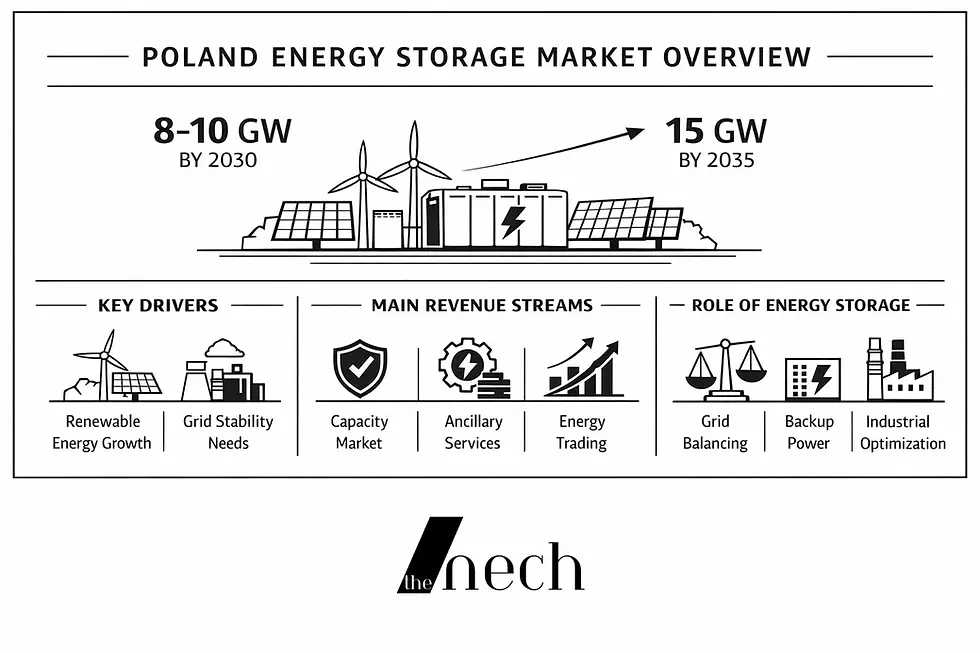
The size and growth of the Polish energy storage market
Although the operational battery storage capacity in Poland is still relatively limited, the development pipeline for new projects is expanding rapidly.
Developers have submitted energy storage projects totaling more than 20 GW of potential capacity in various grid connection applications and investment programs.
Market forecasts suggest that Poland could reach between 8 and 10 GW of installed battery storage capacity by 2030.
Looking further ahead, energy system planning scenarios indicate that the Polish electricity grid may require as much as 15 GW of storage capacity by the mid-2030s to support the integration of renewable energy.
These projections place Poland among the fastest-growing energy storage markets in Europe.
Capacity market: the main revenue model for battery storage projects
Today the most important revenue stream for large-scale battery energy storage projects in Poland is the capacity market.
The Polish capacity market provides long-term contracts that pay energy assets for their availability to support the grid during periods of high demand.
For energy storage developers, these contracts are particularly important because they create predictable long-term revenue streams. Capacity market agreements can last up to 15 or even 17 years.
Financial institutions often rely on these contracts as the foundation for project financing. As a result, many BESS projects in Poland are developed with capacity market participation as a central element of the business model.
However, competition in capacity auctions has been increasing in recent years as more developers enter the market.
Government support and EU funding for energy storage
Public funding mechanisms are also accelerating the development of battery energy storage in Poland.
The European Union’s Modernisation Fund and national investment programs support the deployment of large-scale storage projects across the country.
These programs may cover approximately 45 to 65 percent of project capital expenditure depending on company size and project structure.
Overall investment support programs are expected to mobilize more than one billion euros for energy storage development in Poland.
Demand for these funds significantly exceeds the available budget, which clearly demonstrates the growing interest of developers and investors in the BESS sector.
Legal and regulatory framework for energy storage projects
Despite strong market momentum, the regulatory framework for energy storage in Poland is still evolving.
Energy storage systems are already recognized in Polish energy law and renewable energy legislation. However, several other regulatory areas are still adapting to this technology.
One example is construction law. Polish building regulations do not yet contain a specific legal definition of an energy storage facility.
As a result, energy storage installations are often classified based on similar infrastructure categories.
Large containerized battery storage installations located outdoors are typically considered construction structures and therefore require a building permit.
Smaller energy storage systems installed inside industrial facilities or existing buildings may not require the same level of administrative approval.
Because the regulatory framework is still developing, project classification and permitting processes can sometimes involve legal interpretation.
This situation does not necessarily block energy storage investments, but it can create uncertainty for project developers.
Industrial energy storage: an emerging opportunity
While most discussions focus on large utility-scale storage projects, commercial and industrial energy storage is also becoming an important market segment.
Industrial companies are increasingly exploring battery storage as a tool to manage energy costs and improve energy security.
Battery energy storage systems allow companies to:
reduce peak electricity demand
increase self-consumption of renewable energy
improve power quality
provide backup power during grid interruptions
For many energy-intensive businesses, energy storage can become an important element of energy management strategy.
Future revenue streams for BESS projects
In mature energy storage markets such as the United Kingdom, Germany, and Australia, battery storage projects typically generate revenue from multiple sources.
Poland is gradually moving toward a similar model.
Future revenue streams for BESS projects may include:
capacity market participation
ancillary services for grid stabilization
electricity trading and price arbitrage
balancing market services
flexibility services for renewable energy producers
As renewable energy penetration increases, the value of flexibility in the power system will continue to grow.
Why Poland is attracting international energy storage investors
Several factors make Poland particularly attractive for energy storage investment.
The country has one of the fastest growing renewable energy sectors in Europe. Electricity demand remains strong, and the energy system requires additional flexibility resources.
Government support programs, EU funding mechanisms, and the capacity market provide important financial incentives for project development.
At the same time, the energy transition in Poland is creating long-term demand for technologies that can stabilize the grid and support renewable integration.
For these reasons many international investors view Poland as one of the most promising emerging markets for battery energy storage systems in Europe.
FAQ: Energy Storage Market in Poland
What is a battery energy storage system (BESS)?
A battery energy storage system stores electricity and releases it when the grid or the user needs it. BESS technology is widely used to support renewable energy integration, stabilize electricity networks, and optimize energy consumption.
How large could the energy storage market in Poland become?
Market forecasts indicate that Poland could reach around 8–10 GW of installed battery storage capacity by 2030. Long-term system planning suggests the grid may require up to 15 GW by the mid-2030s.
What are the main revenue streams for energy storage projects in Poland?
The main revenue sources include the capacity market, ancillary services, electricity trading, balancing market services, and flexibility services for renewable energy producers.
Do energy storage projects require a building permit in Poland?
Large outdoor battery storage installations usually require a building permit. Smaller systems installed inside existing buildings may not require the same level of administrative approval.
Why are international companies interested in the Polish BESS market?
Poland combines rapid renewable energy growth, strong electricity demand, supportive funding programs, and increasing need for grid flexibility. These factors make it one of the most attractive energy storage markets in Europe.
Entering the Polish Energy Storage Market
For international companies exploring the energy storage market in Poland, technology alone is rarely enough.
Successful market entry requires a deep understanding of the local regulatory framework, market structure, project development ecosystem, and strategic partnerships within the energy sector.
This is where specialized market advisory becomes important.
the nech works with international energy companies, technology providers, EPC contractors, and investors who are exploring opportunities in emerging energy markets such as Poland and Ukraine.
Typical areas of support include:
energy market entry strategy
BESS and renewable energy market intelligence
business development and partnership building
identification of project opportunities
strategic positioning in new energy markets
As the Polish energy storage market continues to grow, companies that position themselves early are often able to build the strongest partnerships and long-term market presence.
Organizations interested in understanding the opportunities in the Polish energy storage market or exploring business development strategies in Central and Eastern Europe can learn more about advisory services provided by the nech.


Comments