
How Energy Businesses Should Make Decisions About New Markets: Practical Lessons from Dmytro Furdyha, CEO of VOLTAGE Group
- Apr 12
- 14 min read
Ukraine's energy market has become one of the most demanding business environments in Europe. Decisions that would typically take months must now be made in weeks. Dmytro Furdyha, CEO of VOLTAGE Group, speaks exclusively from the perspective of the Ukrainian market — and that is precisely what makes his insights so valuable for any international company considering entry into the Ukrainian energy sector.
War, attacks on energy infrastructure, capacity shortages, rising electricity prices, the growth of distributed generation, battery energy storage systems, and new approaches to energy management have changed more than the technical landscape. They have changed the fundamental logic of how energy businesses operate and grow.
In this context, the most valuable perspective comes not from analysts observing from a distance, but from companies working daily with the market's real constraints, client demands, and technical challenges. A conversation with Furdyha is a practical look at how an energy business identifies new segments, evaluates entry decisions, adapts its team, and maintains focus in a market where opportunities are abundant but resources are always limited.
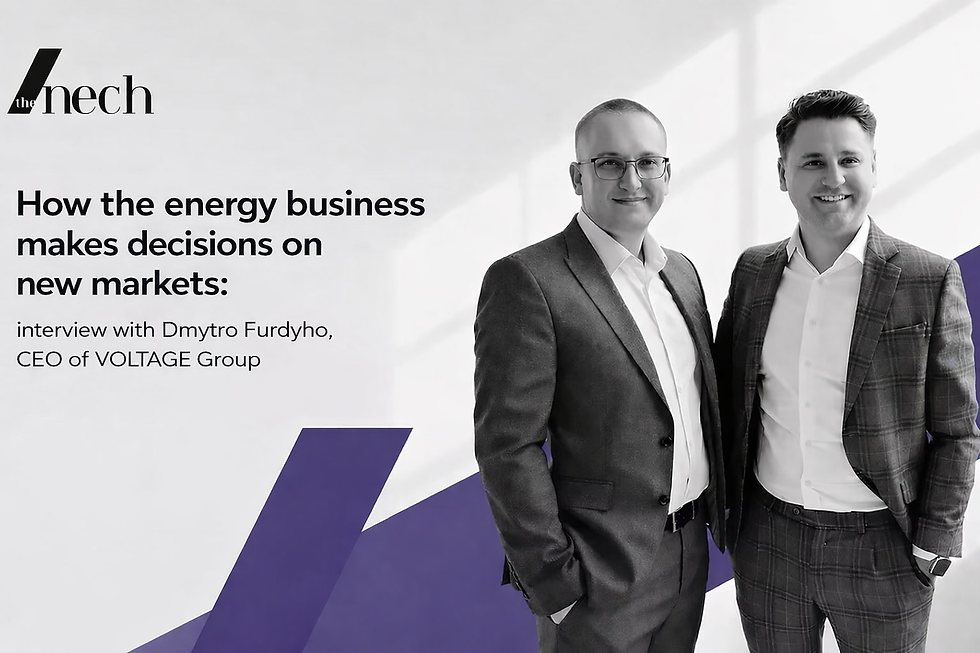
*VOLTAGE Group operates as a full-cycle EPC company in the energy sector. The company delivers projects from initial feasibility studies and project documentation through to construction, commissioning, and ongoing asset management. Its core focus includes solar power plants, wind farms, battery energy storage systems, power transmission lines, substations, and industrial grid connections.
Furdyha does not describe the Ukrainian market as a collection of abstract trends. He describes it as a system of signals that must be read correctly. That framing makes this conversation useful for any company thinking seriously about Ukrainian energy.
A new direction often starts not with a strategy document, but with a client request
The impulse to develop a new business direction very often comes not from an internal strategy session, but from the client. That is one of the key observations in this conversation.
"Very often it is the client itself that shapes the signal — telling us where the company needs to go," says Furdyha.
For companies evaluating entry into the Ukrainian energy market or considering expanding their presence in the sector, this is an important insight. New opportunities do not always emerge from polished market presentations. Far more often, they emerge where a client is already facing a specific problem they cannot solve through standard means.
After the start of the full-scale war, that is exactly what happened. Large clients began calling almost simultaneously — not with abstract questions about modernisation, but with very concrete requests for immediate action.
"Practically every large client we had ever worked with started calling at the same time, asking: help us, what are the options, what can we actually do in this situation?" — the CEO recalls.
The best way to understand where a market is heading is not only to analyse macro trends, but to systematically listen to what clients are saying at the conversation level. When the same problem begins repeating across different segments and different types of buyers — that is no longer coincidence. That is a market signal.
The Ukrainian market moved through several adaptation stages very quickly
Another important aspect of this conversation is how clearly it shows the way Ukraine's energy market evolved after 2022 — and the logic behind each phase.
In the first stage, businesses needed the fastest possible solutions. The logical first response was diesel generators.
"It all started with diesel generators. That's the first thing that comes to mind," Furdyha states.
That stage could not last. After just one winter, it became clear that generators do not provide a viable long-term economic model. Fuel costs, the price per kilowatt-hour, operational constraints, and the overall inefficiency of the approach forced the market to move on.
"After one winter, everyone understood that diesel generators are not a long-term answer," he says.
In the second stage, demand for battery energy storage systems grew rapidly. But here, too, the market quickly encountered a hard limit.
"Storage on its own is an interesting thing — but if there is no electricity at all, storage gives you nothing, because you have nothing to charge it with," the CEO explains.
The solution was clear: storage needed to be combined with on-site generation.
"Adding any kind of generation to the storage — whether cogeneration or solar — is something that performs very well across all metrics," Furdyha notes.
The key lesson: a new market is not static. It moves through stages — from quick fixes to economics, from economics to reliability, integration, and long-term resilience. A company that wants to enter a new segment at the right moment needs to understand not only the technology, but also which stage of demand maturity the market is in right now.
Entering a new segment does not require knowing everything in advance
In many companies, growth stalls not because of a lack of opportunity, but because of a demand for complete certainty. The logic is simple: learn everything first, then enter. In energy, that approach almost always means losing time.
VOLTAGE Group takes a different view. The team has developed a habit of entering new directions not because it ignores risk, but because it relies on a strong technical foundation and the ability to learn fast.
"We were never particularly afraid of picking up something new and trying to work with it," says Furdyha.
He recalls the company's entry into the solar energy segment at a moment when the Ukrainian market was still forming and there was almost no established practice to draw from.
"We didn't fully understand how to do it yet. We were already driving to a forum in Kyiv with drawings and questions about how to connect everything — because the equipment was arriving in two weeks and there was no one to ask," the CEO recalls.
The same pattern repeated itself with battery energy storage systems.
"There was some understanding of how it should work, there were some foundations — but there was no practical experience," he adds.
This is not a romantisation of risk. It is a practical management approach. If a company has a strong technical foundation, a culture of learning, and a willingness to work in close dialogue with partners and clients — it can enter a new segment before a fully standardised solution exists in the market.
New expertise is built through dialogue, not through the illusion of ready answers
How a company builds competence in new technologies is a critical question for any business planning to bring a new product or service to the Ukrainian market. Furdyha's answer is straightforward.
"We say yes, and then we start figuring it out — calling our partners, suppliers, talking to their technical specialists, asking questions," he explains.
"The laws of energy and physics are the same everywhere. We know the fundamentals. The details can be learned by asking direct questions — and only through dialogue," the CEO emphasises.
A strong engineering organisation does not pretend to have all the answers already. It combines fundamental industry understanding with a practical search for solutions that fit the specific site, specific grid, and specific operating scenario.
It is telling that the Ukrainian context regularly forced VOLTAGE Group to ask their European suppliers questions that had no ready answers in normal market conditions.
"The first response from our suppliers, our European partners, was: we don't have solutions for that — our grid doesn't go down," Furdyha recalls.
This is an extremely important detail for international companies. Ukraine's energy market does not always accept standard solutions in their standard configurations. Adaptation is frequently required — for local grid operating modes, for seamless switchover requirements, for the combination of storage, generation, and external grid under non-standard conditions. The competitive advantage here belongs not only to those who have the technology, but to those who can adapt it to Ukrainian operational reality.
In a crisis market, speed becomes part of the value proposition
Another critical theme in this conversation is speed — not simply the pace of project delivery, but the change in the underlying business logic of energy in Ukraine.
Decision-making speed has increased significantly. Partly due to legislative changes, partly because the economics of energy consumption have become far more demanding for businesses.
"Implementation speed is very fast, and I think the speed of client decision-making has also increased substantially," Furdyha notes.
The core financial driver is the price of electricity, which has become a direct operational pressure on every business operating in Ukraine.
"If your kilowatt-hour costs 12 to 15 hryvnias, plus distribution, plus transmission — and you look at the morning and evening price peaks — that's extraordinary," the CEO says.
"You run the basic numbers. If you reduce that cost, you become more competitive — or simply able to function and keep operating at all," he explains.
An energy project in Ukraine today is rarely just an investment in modernisation. It is a decision that affects operational resilience, cost structure, competitiveness, and a company's basic ability to keep running. That is why the winners in this market are not simply competent contractors — they are the ones who can rapidly translate a client's problem into a workable technical and business solution.
The right focus matters more than the volume of incoming requests
When a market is hot, it is very easy to fall into the trap of chasing every lead. From the outside it looks like an ideal situation. In practice, too many requests often dilutes focus and consumes the team's capacity.
VOLTAGE Group maintains a clear focus. The company deliberately works with large industrial projects and does not spread its resources across all requests coming from the market.
"We position ourselves as a company that works with large companies," says Furdyha.
"We build large industrial facilities. We cannot afford to take smaller projects — because we would simply be using our resources inefficiently," he explains.
This is not simply a question of scale. It is a question of management discipline, strategic focus, and the correct deployment of internal capacity. When a company understands clearly where it creates the most value, it stops thinking in terms of the number of opportunities and starts thinking in terms of portfolio quality.
There is a second filter: economic viability.
"Very often, during early-stage discussions, we look at whether this project will actually be built — or whether at some point everyone will realise it simply doesn't make economic sense," the CEO states.
Do not take a project just because it appeared. Do not confuse activity with results. Do not load a team with work that will deliver neither a strong outcome for the client nor a healthy return for the company. That is a mature approach — and it clearly distinguishes companies that are growing strategically from those that are simply reacting to the market.
Trends that are already shaping the Ukrainian energy market
The conversation with Furdyha reveals not only a picture of the current Ukrainian market, but also how he sees the logic of its near-term development. These are not abstract forecasts — they are directions already influencing the decisions of investors, energy consumers, and contractors operating in Ukraine today.
Distributed generation has moved out of the niche
The first key trend Furdyha identifies is distributed generation.
"This is trend number one," he says, without elaboration.
The reason is clear. The war exposed the vulnerability of large, concentrated generation assets and simultaneously demonstrated the value of local generation — closer to the point of consumption and more resilient from a physical security standpoint.
"If everyone is generating everywhere — that becomes very hard to destroy," the CEO explains.
This is not only about security. It is also about reduced transmission losses, operational flexibility, faster implementation timelines, and, in many cases, better economics for individual businesses.
Wind energy needs to grow its share
The second direction is the expanding role of wind farms in Ukraine.
"The share of wind projects in Ukraine needs to grow significantly," Furdyha emphasises.
The logic is practical. Solar generation remains important, but the energy system needs a more balanced generation structure, particularly given seasonal variation and load profiles. Wind projects are longer to develop and more capital-intensive, but they provide what solar generation alone cannot: output not just during daylight hours, but also at night and during winter months when solar yield is lowest.
Energy management is becoming its own value zone
The third major trend goes beyond equipment and into the logic of energy system management. This includes a growing demand for battery energy storage systems as a tool for increasing the value and controllability of existing generation assets.
"Our energy system is undergoing a fundamental transformation," Furdyha states.
"Management technologies and smart grid technologies are being integrated into it," he adds.
Simply adding more generation capacity does not solve all the challenges. The next level of efficiency is determined by how well a company can manage generation, storage, consumption, and market scenarios in real time. This is driving the growing importance of EMS solutions, SCADA systems, and energy management platforms that give business leadership a complete picture at the enterprise or asset portfolio level.
The most memorable image in the entire conversation appears here:
"Build me a flight control centre right here in my office — for all of my facilities," Furdyha describes, citing a client's exact words.
That is the language of business without unnecessary theory. The client wants not just equipment, but a management system that shows in real time how much is being consumed, how much is being generated, where substitution is happening, where savings are emerging, and how to control all of it.
AI in energy is not yet replacing engineering judgment — but it is becoming a useful tool
Furdyha's position on artificial intelligence is neither inflated optimism nor flat dismissal. That balance is the most mature take available.
"There is an impact, but it is genuinely difficult to measure," he admits.
"You can automate a part of the work — but not all of it, because designing strong systems is a very creative process," the CEO explains.
Where the work involves pre-project analysis, accumulated internal case studies, finding analogues, or preliminary analytics, AI provides a meaningful capability boost. But where the task involves a complex technical solution for a specific real-world site, engineering judgment remains the determining factor.
AI does not yet replace a company's ability to think. But it can meaningfully enhance its ability to work faster, more systematically, and at greater scale.
Grid context is becoming increasingly critical for new projects
As the number of new generation assets and battery energy storage systems grows across Ukraine, grid capacity is becoming an increasingly practical constraint. Project decisions today depend not only on technology or equipment cost, but on connection availability, available grid headroom, and the overall economics of grid access.
"The cost of connecting to the electricity grid will increase," Furdyha warns.
For investors, developers, and industrial energy users, the implication is clear: grid context assessment must be part of the decision before project development begins — not a deferred question expected to resolve itself.
Risk appetite has grown — and it has become a management position
In a demanding environment, management style changes not through theory, but through experience. Furdyha is direct about this.
"You need to dream more and step into new things more easily," he says.
"It became clear that you have to try. Some things will survive, some won't. But whatever survives — you will inevitably become the winner in it," the CEO adds.
This is convincing precisely because it is grounded in practical experience, not abstract motivation. The company does not wait for complete certainty — it assesses the opportunity quickly, makes a decision, and moves forward.
"Our appetite for risk has grown. We understand that we need to move actively and quickly," Furdyha states.
This is not about unstructured risk-taking. It is about the capacity not to be stopped by uncertainty when the market demands action, speed, and decisive management.
A team for a new market needs to be not only strong, but thinking
The approach to people is a natural continuation of the management theme. Furdyha's message here is clear.
"We look for people who won't just execute their work very well. Someone who can also create, and think, and question," he says.
In a market where standard projects are becoming fewer and non-standard solutions are becoming more common, this matters. Companies that want to grow in new segments need people capable of working with uncertainty, asking the right questions, and participating in the development of new approaches.
"In practice, this gives us the ability to go first on certain projects — to be the ones doing something for the first time," the CEO concludes.
This conversation is not just an interview about one company. It is a practical business case with five clear takeaways about the Ukrainian energy market.
First, new directions in energy are born not from theory, but from real client requests. Second, entering a new segment almost never happens with full certainty — the competitive advantage lies in a strong foundation, fast learning, and the ability to build the right technical dialogue. Third, the market is moving steadily from individual equipment toward system-level solutions, where management logic, economics, operating modes, and grid interaction all matter. Fourth, a large volume of incoming requests is not a reason to pursue everything — growth often begins precisely with the discipline to say no to what does not fit the positioning or project economics. Fifth, in new markets, the winners are teams where people can not only execute well, but think, adapt, and participate in finding solutions where no ready answers yet exist.
Ukraine's energy market is opening significant opportunities for international players — investors, equipment manufacturers, EPC contractors, developers, and service companies. But it works best for those who enter not with ready-made templates, but with a realistic understanding of context — and a genuine willingness to adapt faster than the market itself.
Furdyha puts it most simply:
"Love what you do — and it will definitely be successful," he says.
In business terms, that translates to this: the best results in a demanding market typically go to teams that are not merely present in the sector, but deeply understand its logic, are prepared to learn faster than others, and have enough internal conviction to move into new directions before those directions become obvious to everyone.
FAQ
How can an energy company recognise when it is time to enter a new segment of the Ukrainian market?
One of the strongest signals comes from the market itself — through client requests. When similar problems keep appearing in conversations with buyers, new demand is forming. In energy, a new segment often begins not with a theoretical forecast, but with a specific client pain point that can no longer be solved through standard tools.
What matters more when entering the Ukrainian market: existing expertise or the ability to learn fast?
In most cases, both matter — but the decisive factor is usually the ability to learn quickly on top of a solid technical foundation. New segments rarely come with complete certainty. A company with strong fundamentals, a capable team, and the ability to work in close dialogue with suppliers, partners, and clients typically gains an advantage faster than those waiting for a perfectly clear moment.
Why does the Ukrainian energy market require local understanding?
Ukraine's energy market has its own operational and grid-level specifics. Standard solutions that work in Western European markets cannot always be transferred without adaptation. This is why entering the Ukrainian market requires understanding the local context — grid logic, the behaviour of industrial energy consumers, reliability requirements, and the practical operating scenarios of energy systems under wartime conditions.
Which directions are currently most promising in Ukrainian energy?
Among the key directions: distributed generation, battery energy storage systems, BESS integrated with generation, wind energy development, automated energy management systems, EMS solutions, and smart grid tools. The attractiveness of each direction depends on client type, grid situation, project economics, and the specific business model.
Why have battery energy storage systems become so important for the Ukrainian market?
BESS became important because of the need for backup capacity, increased flexibility, cost reduction, and better energy consumption management. But in practice, they create the most value when combined with on-site generation or as part of a comprehensive energy solution — not as a standalone tool.
How can a company maintain focus in a hot market with a high volume of incoming requests?
Focus is maintained through clear positioning, a well-defined client model, and discipline in project selection. A large number of requests does not mean all of them are equally valuable. A company should evaluate scale, economics, delivery realism, and how well a project fits its available resources and strategic positioning.
What role does speed play in energy business development in Ukraine today?
Speed has become one of the key competitive advantages. This applies to the speed of analysis, decision-making, technical adaptation, and project launch. When electricity costs directly affect production unit economics and operational stability, clients expect not only a good solution but also the ability to move quickly from decision to implementation.
Can AI genuinely help energy companies operating in Ukraine?
Yes — but AI works best as an amplifier of engineering expertise, not a replacement for it. It can be used for pre-project analytics, internal knowledge management, finding comparable cases, structuring technical information, and accelerating specific processes. Complex engineering decisions for real-world projects still require strong professional teams.
Why is grid context becoming increasingly important for new energy projects in Ukraine?
Because project economics increasingly depend not only on equipment and construction cost, but on connection availability, grid headroom, connection cost, and technical constraints. For investors and developers, grid context assessment must be part of the decision before project development begins — not a deferred item.
What gives a company a competitive edge in a new Ukrainian energy segment?
Most often it is a combination of factors: a strong technical foundation, fast learning, the right team, the ability to work with uncertainty, clear positioning, and the ability to convert a client's request into a practical solution. In new segments, the winners are not only those who have the technology — but those who can apply it correctly in the specific market context.


Comments